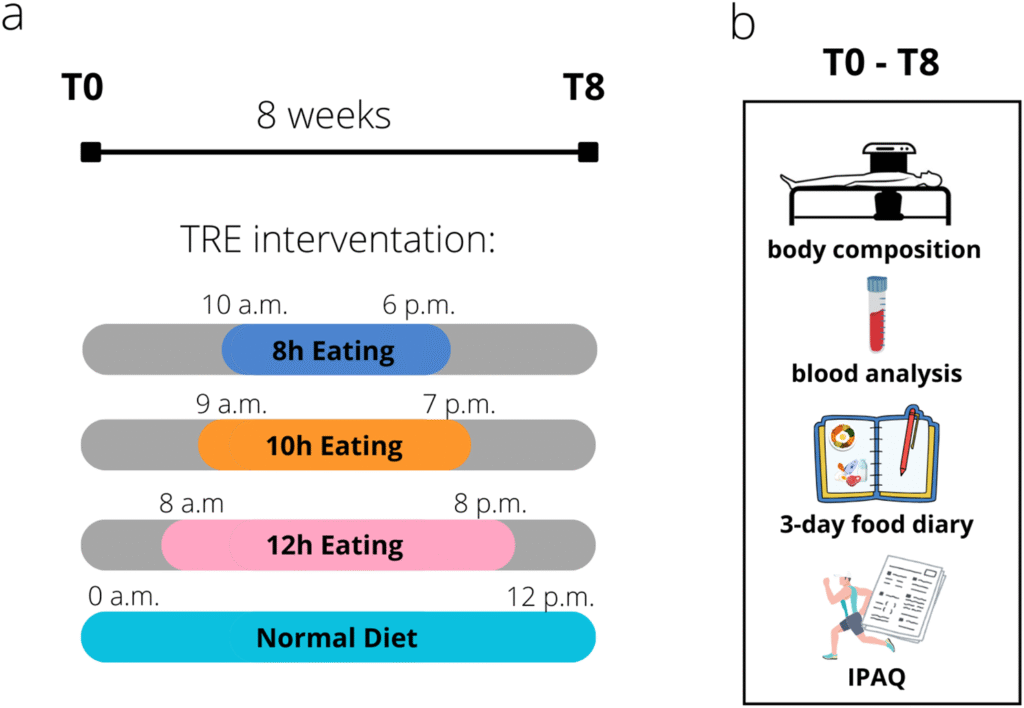
Picture from: “Impact of daily fasting duration on body composition and cardiometabolic risk factors during a time-restricted eating protocol: a randomized controlled trial”
Download PDF: s12967-024-05849-6.PDF
AI:
“Calorie window” typically refers to the specific time frame within which an individual consumes all their daily calories. It’s often associated with time-restricted eating or intermittent fasting, where the goal is to restrict food intake to a specific number of hours each day.
Elaboration:
- Time-Restricted Eating:This eating pattern involves restricting the daily “calorie window” to a specific number of hours, while fasting for the remaining hours. A common example is the 16:8 method, where you eat within an 8-hour window and fast for 16 hours.
- Purpose:The primary aim of restricting the calorie window is to help individuals manage their calorie intake, potentially leading to weight loss or other health benefits.
- Adherence:Studies have shown that adherence to the calorie window is crucial for success. Participants who can maintain the eating pattern consistently tend to achieve better results according to Medscape.
- Other contexts:The term “calorie window” can also appear in the context of fitness equipment, where it refers to a display showing remaining calories during a workout. For example, some treadmills have a calorie window that counts down to zero as you exercise.